
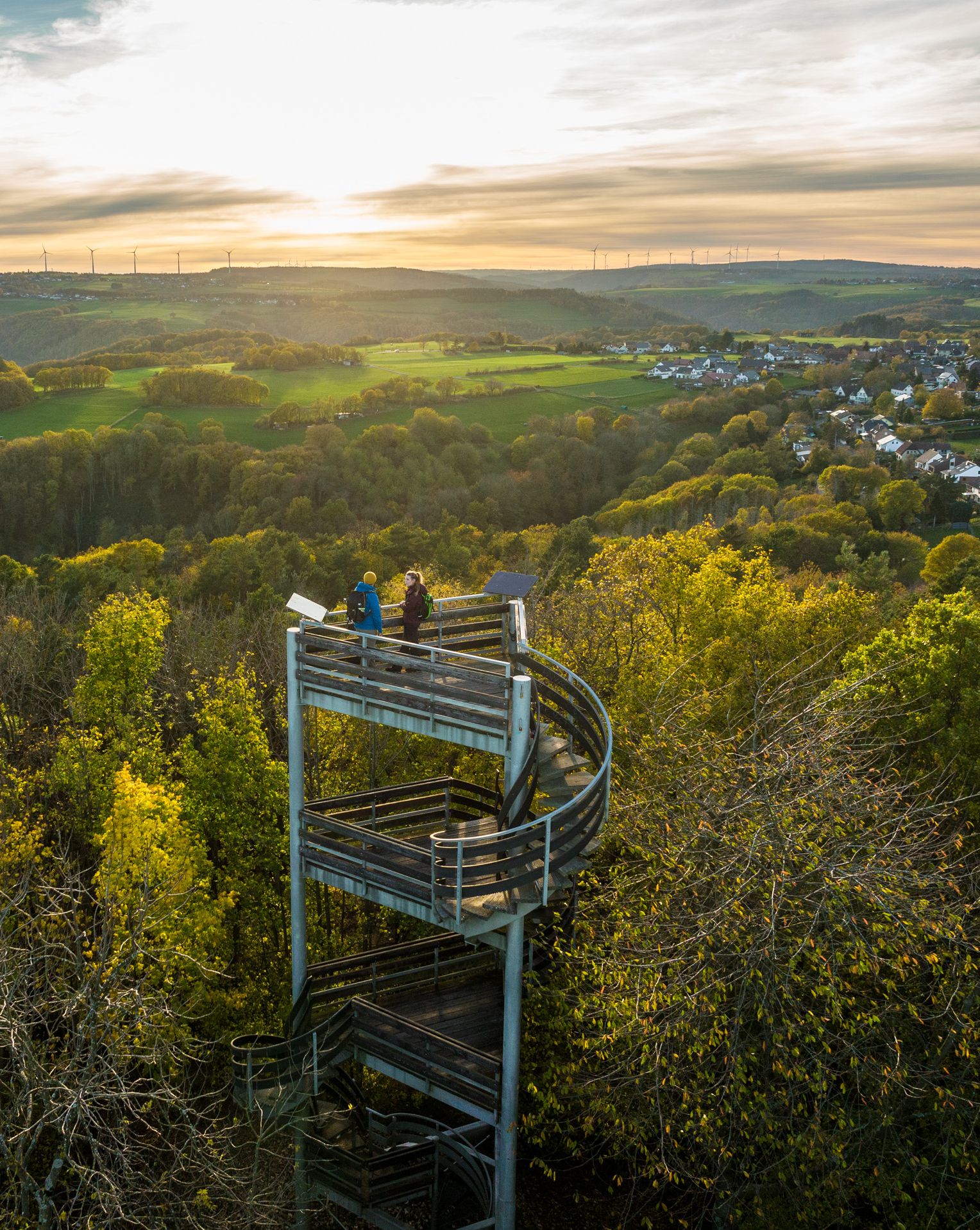
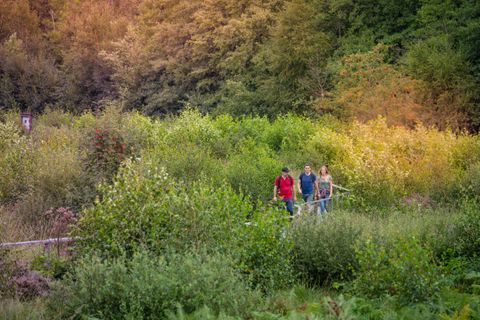
Copyright: Eifel Tourismus GmbH, Dominik Ketz
Cycling & Hiking Tours
23 results

Hiking
Kleiner Rundwanderweg [06]
HürtgenwaldDistance:5.5 km
Duration:1:30 h
Difficulty:Easy
Circular route / 5.5 km
Hiking
Weheschlucht [46]
HürtgenwaldDistance:14.0 km
Duration:3:47 h
Difficulty:Medium
The deeply carved valley of the Weiße Wehe gives this hiking trail its name. The starting point is the "Zum Alten Forsthaus" hotel in Vossenack. The Wehebach originates from the confluence of the "Roter Wehe" and "Weißer Wehe" rivers. In 1981, six Polish beavers were settled in the Weiße Wehe valley. Until the 19th century, the rodents were hunted for their fur, declared fish by the Pope, eaten during Lent and used as an aphrodisiac. The consequence was their almost complete extinction. Today, the Eifel population is once again estimated at 200 to 250 animals. Guided hikes follow the tracks of the beaver. We follow hiking trail no. 46 .
Hiking
Heinrich-Boell-Weg [35]
HürtgenwaldDistance:6.2 km
Duration:2:00 h
Difficulty:Easy
On the evening of September 11, 1944, just fourteen weeks after the Normandy landings, the 1st US Army stood on the German border and on the Siegfried Line, a line that was not actually to be reached until May 1945.
Hiking
Archäologischer Wanderweg Hürtgenwald 1944-45 [94]
HürtgenwaldDistance:4.1 km
Duration:1:15 h
Difficulty:Easy
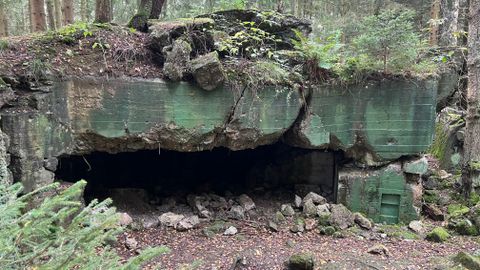
This trail takes you to US positions from the time of the fighting in the Hürtgenwald in 1944-45, which have been investigated and mapped by the LVR Office for the Preservation of Monuments.
Cycling
Seeblick [C] | MTB-Tour Freifahrt Eifel
HürtgenwaldDistance:29.7 km
Duration:4:20 h
Difficulty:Medium
The undulating forest and panoramic trails around the Obermaubach reservoir require a relatively high level of fitness.
Hiking
Westwall-Weg [86]
HürtgenwaldDistance:8.0 km
Duration:2:45 h
Difficulty:Medium
Since the beginning of our era, Western Europe has been cut through by fortified border fortifications, such as the Roman Limes, the medieval castle line or the forts of the 19th century.
Cycling
Talfahrt [D] | MTB-Tour Freifahrt Eifel
HürtgenwaldDistance:21.3 km
Duration:3:00 h
Difficulty:Medium
This tour is varied and only moderately challenging with a steep single trail north of Vossenack. It leads over gentle undulations and steeper climbs from the plateau of the Hürtgen Forest into the adjacent valleys. You can start the low-traffic circuit from one of the parking lots, e.g. in Vossenack (church) or Hürtgen (cemetery or sports field) or Germeter (parking lot at the edge of the forest, Zweifaller Weg).
Hiking
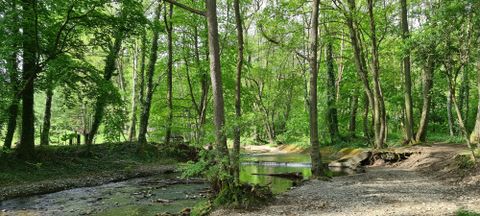
Panoramaweg Bergstein [15]
HürtgenwaldDistance:9.4 km
Duration:2:30 h
Difficulty:Medium
Circular trail - 9.4 km - from the hiking parking lot at the church in Bergstein
Hiking
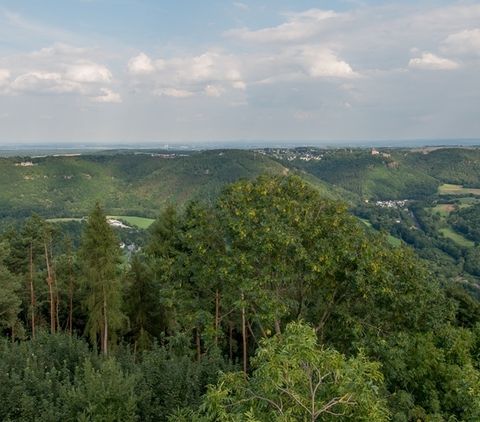
Kalltalweg [25]
HürtgenwaldDistance:7.4 km
Duration:2:00 h
Difficulty:Medium
The Kalltalweg leads as circular trail no. 25 from the national park information point in Zerkall along the Kall past the Renker & Söhne paper factory, through alder gallery forests and flower-rich smooth oat meadows back to the starting point.
Cycling
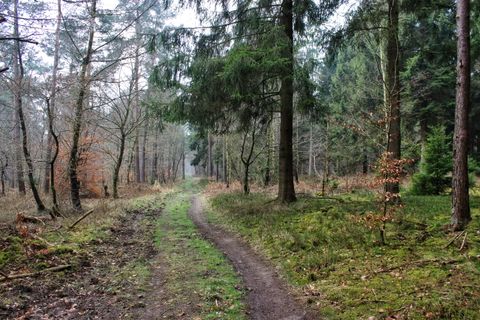
Krawutschketour [E] | MTB-Tour Freifahrt Eifel
HürtgenwaldDistance:14.8 km
Duration:2:10 h
Difficulty:Medium
This loop, roughly around Bergstein and the Krawutschke observation tower, is short and crisp in terms of fitness with a strong main ascent between the Kalltal valley and the high-altitude villages of Brandenberg and Bergstein. You cycle clockwise, first relatively flat through the Kall and Tiefenbach valleys, then steeply up to Brandenberg and later very steeply down again to Zerkall. Here you will find the national park information point, which is also the start and end point of the route. Alternatives are the train station parking lot or the parking lots of the church in Zerkall or the parking lots of the Krawutschketurm in Bergstein.
Hiking
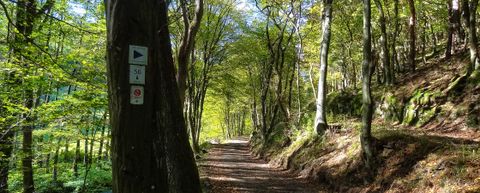
Thönbach [34]
HürtgenwaldDistance:7.0 km
Duration:2:00 h
Difficulty:Easy
Circular hike / 7 km
Hiking
4 Täler [56]
HürtgenwaldDistance:11.3 km
Duration:4:00 h
Difficulty:Medium
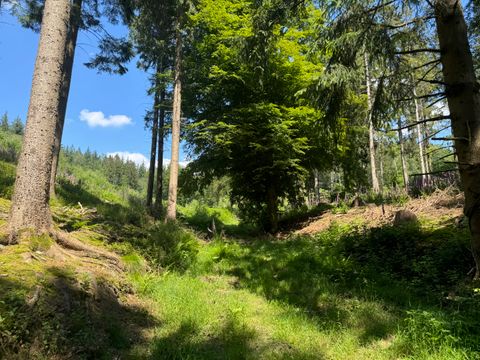
The watercourses and their floodplains are a typical and ecologically valuable part of the Rureifel with a great wealth of flora and fauna. This diversity is thanks to the farmers who have mowed the meadows for centuries. When modern forms of farming close to villages made haymaking in the valleys no longer worthwhile, spruce trees were planted there. Efforts are currently being made in many places to restore the original floodplain vegetation. The characteristic terracing can be seen in many places along the hiking trail. This occurs when a river is no longer able to transport its debris load and deposits it in the floodplain. If a river deepens again due to a change in climate, it cuts through the previously formed terrace. The formerly swampy valleys of the Eifel only acquired their function as traffic routes after the river regulation at the beginning of the 20th century.
Hiking
Paul-Boesch-Weg [76]
HürtgenwaldDistance:6.5 km
Duration:2:00 h
Difficulty:Medium
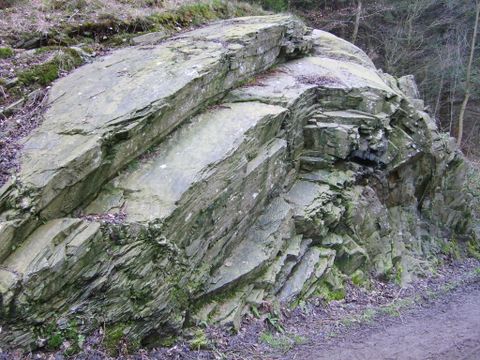
After months of fighting, the area around the "Wilde Sau" forest district had become the "Killing Field" of the Western Front. Regiments of three American divisions, the 9th, 28th and 4th, had fought here and suffered heavy losses.
Hiking
Historischer Wanderweg [36]
HürtgenwaldDifficulty:Medium
Circular hike - 15.3 km

Hiking
Biberweg [05]
HürtgenwaldDistance:16.4 km
Duration:4:20 h
Difficulty:Medium
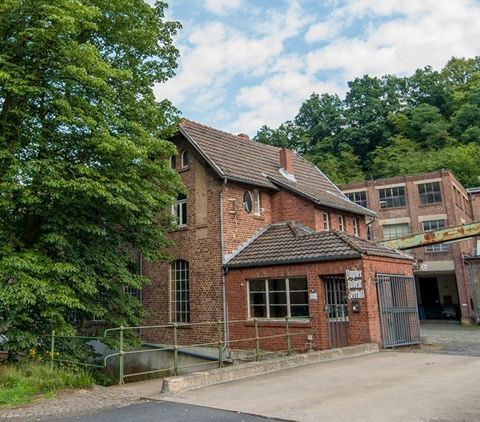
Start of the hike in Hürtgenwald at the "Brandenburger Tor" parking lot. Follow the signposts of the Eifelverein 05 along the Hürtgenbach in the direction of the Südzipfelder Wehebachtalsperre, but turn off here at Gressenicher Weg and continue in the direction of "Rote Wehe". Follow the course of the stream until the "Alte Zweifaller Straße" junction, turning left into the forest towards the "Weiße Wehe" stream and back to the starting point.
Cycling
An der Kall-Aue [G] | MTB-Tour Freifahrt Eifel
HürtgenwaldDistance:21.9 km
Duration:2:47 h
Difficulty:Medium
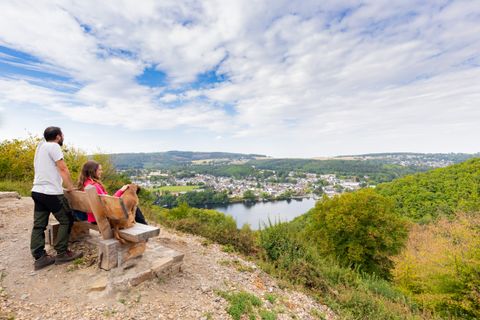
From the narrow Rur valley along the wooded valleys of Kallbach and Schlehbach, the route climbs up to the windy plateau of Schmidt. In terms of riding technique, the route is suitable for everyone, as apart from a steep, long single trail between Zweifallshammer and Schmidt, the route is mostly easy. Here you are directly connected to the national park information point in Zerkall with a parking lot, but you can also easily travel by train to Nideggen-Brück station. Parking is also available in Nideggen at Zweifallshammer, at Schmidt-Scheidbaum, in Kommmerscheid or in Mausbach.
Hiking
Felspassage [07]
HürtgenwaldDistance:12.9 km
Duration:3:45 h
Difficulty:Difficult
Hike through the red sandstone rocks of the Rureifel
Hiking
Ochsenkopf-Weg [96]
HürtgenwaldDistance:9.3 km
Duration:2:30 h
Difficulty:Easy
On a day in autumn, when wisps of mist drift through the spruce forests like ghosts, you can sense here on the Ochsenkopf a little of what made the forest battles so eerie for the soldiers on both sides and contributed to the myths and legends of the Hürtgen Forest.
Hiking
Bodenlehrpfad "Todtenbruch"
HürtgenwaldDistance:4.0 km
Duration:1:00 h
Difficulty:Easy
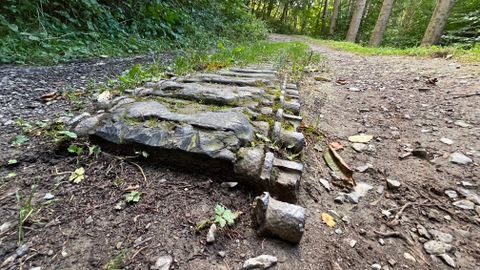
The 4.0 km long educational soil trail leads along a 700 meter long boardwalk directly over the sensitive soils and through the source area of the Weiße Wehe.

Cycling
Panoramaschleife [F] | MTB-Tour Freifahrt Eifel
HürtgenwaldDistance:29.5 km
Duration:4:28 h
Difficulty:Medium
Steep descents and equally crisp climbs over several single trails require not only fitness but also technical skills. If that's not enough to exhaust you, you can clear your head on the windy plateaus of Schmidt and Hürtgenwald at the latest. Parking is available at the church in Vossenack and at the Zweifallshammer in Simonskall.
Hiking
Kall Trail [66]
HürtgenwaldDistance:8.8 km
Duration:2:30 h
Difficulty:Medium
Hike from Vossenack through the Kalltal valley to Schmidt-Kommerscheidt. Follow the number 66.

Hiking
Ardbinna Wanderweg [04]
HürtgenwaldDistance:19.8 km
Duration:5:15 h
Difficulty:Medium
Circular route - 19.8 km
Hiking
Hemingway-Trail [44]
HürtgenwaldDistance:16.1 km
Duration:4:00 h
Difficulty:Medium
A few days after the disaster of the "Battle of All Souls", Eisenhower's planned advance to the Rhine began on November 16, 1944 with "Operation Queen", the largest tactical air attack in support of ground troops during the entire Second World War.