Galmeiveilchen
Stolberg
Viola lutea calaminaria
The galmeiflora at this site represents a globally unique plant community that is specially adapted to the ore-bearing soils. It belongs to a glacial alpine relict flora whose species were displaced from their original distribution areas during the glaciation of the last ice age into ice-free climate zones, including the Stolberg area, where they were able to survive the ice age. After the end of the Ice Age, when the vegetation became more lush again, the species of galmeiflora retreated to poorer, nutrient-poor and mineral-laden soils, which were avoided by other, stronger-growing plants.
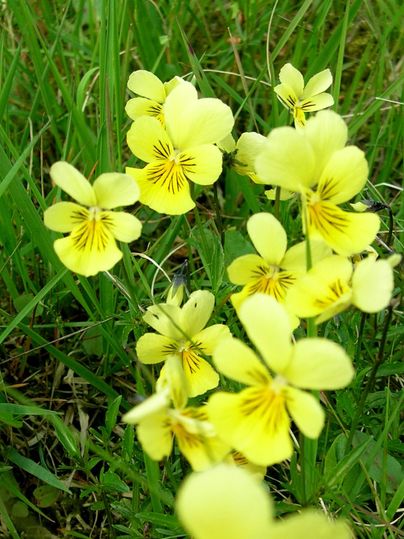
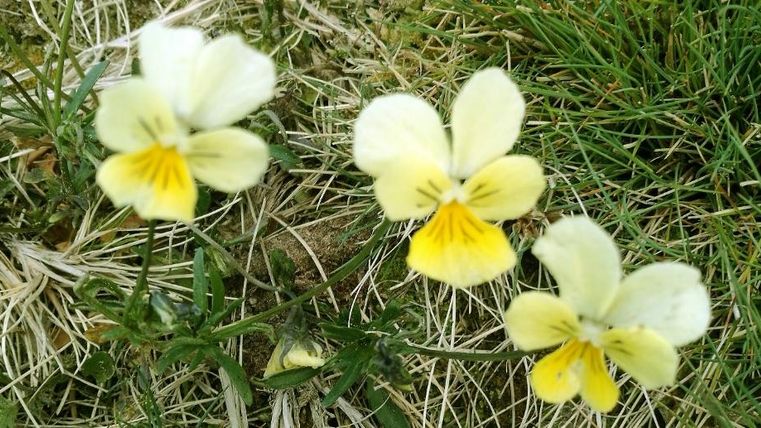
A striking example of this flora is the galmei violet, whose name is derived from the soil containing galmei. Galmei is a collective term for a mineral mixture of various sulphur-free zinc ores, which was of great economic importance until the beginning of the 19th century, as it was indispensable for the production of brass. The galmeiflora grows almost exclusively on former ore fields, some of whose surfaces contain high and toxic zinc, lead and cadmium compounds.
In the course of evolution, the galmeiflora has developed a remarkable tolerance to heavy metals. As a result, survival niches for the heavy metal-resistant plant species, the so-called metallophytes, have been able to establish themselves in these extreme locations. The galmei violet is found worldwide only in the Stolberg region and in the area around Kelmis, southwest of Aachen. It is optimally adapted to the hostile subsoil and can store and accumulate heavy metals without being harmed. For centuries, such plants served the miners as natural signposts to the zinc ore deposits. The calamine violet is strictly protected and may not be picked or dug up.
Impressions

Contact
Panoramarundweg Mausbach
52224 Stolberg